Thursday, 5 December 2013

Why Low Cost CGI Could Prove More Costly In The Long Run


The CGI market is a busy one these days. Improvements in technology and communication mean that you are no longer restricted to local companies: it’s a truly global market and with that comes unprecedented choice. So, how do you select a company to work with? Skill levels? Reputation? Turnaround times? Or budget? For many, budget is the obvious choice and this is understandable in a financial climate where project budgets are squeezed and everyone is demanding more for less (your clients included). But is low-cost CGI always what it seems? We think not, and here are some of our reasons why…

The most important distinction between suppliers is CGI production vs 3D artistry. A production house is very much a technical facility, great at following instructions, but you will need to do the bulk of the background work. The onus is on you, the commissioner, to make sure that the information you provide leads to the result that you want. If there is a gap or a contradiction in your assets, then you could run into problems. 3D Artists, on the other hand, can work as consultants alongside you. They can take on as much of the process as you need: from advising on the best compositions, to commissioning the best photography, through to feeding back on what’s working, what’s not working and why. They are more than just your suppliers: they are your collaborators. I probably don’t need to spell out why this can save you money: we’ve all been there at some point in our lives. Perhaps it’s the cheap electrician that had to come back three times to get the job right, and then you had to get the work re-done six-months later anyway…

So, a CGI consultancy will often save you time in the long run. The 3D Artists are talented at spotting any pitfalls early in the process and advising on the best ways around them. This is critical when you’re working under pressure to a tight deadline. You may find that you do not have the time to micro-manage the process. The time that you spend project managing has a cost (albeit hidden) that needs to be factored into the end budget because that’s time that you can’t spend working on your other projects.

Then let’s not forget quality. Input throughout the process from talented artists who treat the CGI process as a service, rather than simple product delivery, can mean that you get a finished image that is better than you ever imagined. If imagery is a critical part of the decision-making process on your competition or scheme, then getting the best images you possibly can becomes the most economical decision you can take.

There is definitely a place for both types of CGI and you may find that certain projects actually warrant the low-cost approach. Just be aware of the potential pitfalls and ensure that it doesn’t end up costing you more in the long run.

If you would like to speak to us about CGI then please contact Charlotte on 020 7426 2080 or charlotte@assemblystudios.com


Monday, 2 December 2013

Sculpture in the City


If you are in the mood for a stroll on one of these crisp winter mornings, we can highly recommend checking out Sculpture in the City, a free outdoor sculpture exhibition in the City of London curated by Arts Consultant and Cultural Producer, Stella Ioannou. It features site-specific installations from nine artists, including The Chapman Brothers, Anthony Gormley and Richard Wentworth. Artists’ work has been produced ‘in response to the surrounding architecture and built environment’ which made us smile when we saw Jake and Dinos Chapman’s fairytale dinosaurs titled ‘The Good, The Bad and The Ugly’. We won’t speculate as to what they may have been referring! Sculptures range from the humorous (as already mentioned) to the poignant: Robert Indiana’s LOVE sculpture, which sits on the site of an IRA bomb 20 years ago in Bishopsgate.

Our Managing Director, Richard attended one of the Sculpture in the City debates, and these are his gorgeous pictures of the London skyline. There was some interesting discussion around the place for public art, something that Ryan Gander tackled head-on in his installation ‘More Shiny Things That Don’t Really Mean Anything’. Public sculpture through history has so often been about asserting the importance of an individual, or institution, that perhaps it hasn’t really meant anything to the public that it is apparently for. Keith Coventry's pieces ‘Bench’ and ‘Mare Street’ could be said to represent the urban environment as the majority of city dwellers more commonly experience it.

Public sculpture will always be a contentious issue, as is any intervention that changes the space around us. There will always be arguments, debate and the accusation of wasted money but that means that people are looking and thinking about the city they occupy and that has to be a good thing.

Sculpture in the City runs until May 2014 in various locations around the Square Mile.


Monday, 4 November 2013

Things we like - PART #02


This hilariously weird image is the result of a collaboration between Mica Angela Hendricks and her four year old daughter – Hendricks draws the heads, then her daughter draws the rest of the picture. See more here.


(Selected by Rosi Digne-Malcolm, Junior Designer)

Monday, 30 September 2013

Things we like... PART #01


Not for the needle-phobes – innovative lettering from Barcelona-based Lo Siento uses food-dye-filled bubble wrap to create this super-tactile piece for Wired Magazine. 

(Selected by Rosi Digne-Malcolm, Junior Designer)


Thursday, 19 September 2013

London Design Festival 2013

The London Design Festival is held each year to celebrate and promote London as the design capital of the world, and as the gateway to the international creative community. It is in full swing right now and here at Assembly we've been busy picking the best bits - one of the events was the launch party for a Feix&Merlin pop-up shop in Seven Dials, Covent Garden.

Feix&Merlin Architects and artist Nathaniel Rackowe collaborated on an experimental temporary installation on the ground floor of the shop. It bears the mystic name eLP44 and not only does it disconcert by its name, but also when you see your reflection in it!


As a viewer you move through the mirrored film installation and see the environment changing constantly - asking you to reassess the your relationship with the surrounding architecture. 

Check out some more images below, which show the collection of product and lighting designs launched yesterday.


 London Design Festival is still running until 22 September 2013, so do check it out if you get a chance!

Thursday, 29 August 2013

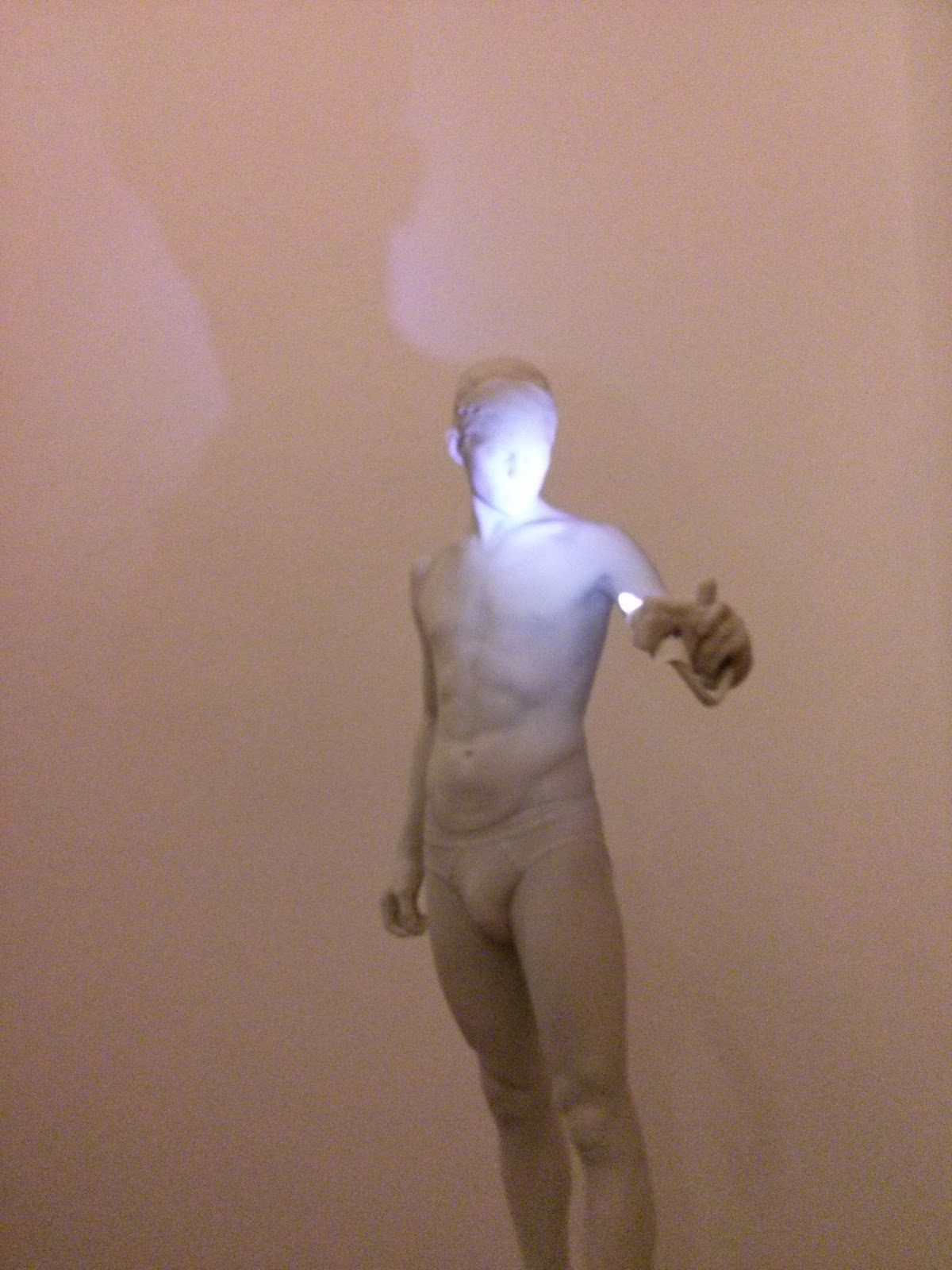
The Future's Bright: A New Way To Paint With Light


While exploring 3D light projections for a recent research & development 
project, I came across a fascinating concept
 that uses light to bring seemingly banal spaces to life. As I have a
 background in photography, I was intrigued by the way this installation demonstrated the way
 you can literally paint a scene with light to reveal aspects of your 
choosing. This gives you control over how a viewer interprets the
 space and, in a sense, you become the director of your own creation.


I have seen a number of similar light projection projects using buildings
 as a canvas, but this is more unusual, more abstract and at a different
 scale; in a way you could say it is more liberated than its predecessors. The input and control from widely available kinetic devices makes me wonder whether such projections will
 become more widespread in the future, grasping public attention and imagination in much the same way as 3D printing, bringing this dynamic 
and exciting art form to the masses. I for one hope so.

Patterns Emerge, by Nature Graphique can be seen online here.

(Written by David Connolly, Assembly Studios' Head of CGI)


-------------------------------------------------------------------------


Download our Guide "Zero Risk Approach to CGI " 


Designing the Unimaginable


What if architects were liberated from the constraints of their imagination? What would the world be like then? This is the central idea in architect Michael Hansmeyer’s inspiring TED talk, Building Unimaginable Shapes.
Hansmeyer has taken inspiration from nature, specifically the division of cells, to design a process that can then be used to create new and ‘unimaginable’ shapes and structures. The idea is simple: take a cube, and fold it, and fold it, and fold it, sometimes hundreds and thousands of times. The creation of a computer algorithm makes this process, that is both simple, yet impossible for humans to carry out, feasible. The outcome is anything but simple: resulting shapes are so deeply complex that they push the limits of what the human eye can see. Millions of surfaces weave and intersect in organic flourishes, reminiscent of microscopic details of crystalline structures.
An interesting exploration perhaps, but is it anything more than this? Does the natural environment serve humans well? Or is architecture used as a way to control the environment in which we live: a way of making inhospitable natural environments habitable? Perhaps we should be asking ourselves: why is this process useful? What is the benefit in building these deeply complex hitherto unimaginable shapes? As art? As decoration? Simply because we can? Or is it an important stepping-stone to a more autonomous design-process that could eventually be affected by contextual considerations, like an organism that grows and changes in response to its surroundings? Or does the introduction of contextual adaptations just make it another tool in a designer’s toolbox?
The talk certainly raises interesting questions about the limits and applications of the human imagination, but more than this, it showcases some genuinely awe-inspiring architectural forms. The resulting structures are reminiscent of a post-apocalyptic landscape that wouldn’t look out of place in films like Alien or Oblivion.
Could these forms be scaled up into human colonies to meet the needs of overpopulated cities? I’m not sure, but I’m certainly enjoying imagining it!
Building Unimaginable Shapes can be viewed here.

(Written by Richard Conner, Assembly Studios' Managing Director).
What do you think? Share your thoughts below.

----------------------------------------------------------------